The 2026 cohort of Experimental Physics Investigators is a distinguished group of mid-career researchers pushing the boundaries of experimental physics. These 21 new investigators join scientists from four previous cohorts in advancing the frontiers of fundamental research in experimental physics.
The Gordon and Betty Moore Foundation's Experimental Physics Investigators Initiative is providing these 21 investigators with $1.35 million over five years to give these scientists the flexibility to accelerate breakthroughs.
“With nearly 100 investigators now at work, we are seeing the range of bold, original science we hoped this Initiative would make possible," said Theodore Hodapp, program director for the Initiative. "From the start, our aim has been to accelerate progress at the frontier of experimental physics by giving brilliant mid-career scientists the kind of flexible, sustained support that federal grants rarely can. That freedom lets them take on risky, high-reward experiments and follow ideas when research results lead them down new pathways.”
Selected from a range of specialties, this year's cohort spans condensed matter; fluid dynamics; nuclear physics; quantum information; soft matter; and atomic, molecular, and optical physics. Among them:
- Benjamin Crider from Mississippi State University is tackling a stubborn blind spot in nuclear physics: When a fragile, neutron-rich nucleus decays and ejects neutrons, today's detectors often cannot distinguish the sequence and timing with which those neutrons are emitted. By building a compact detector that pinpoints where and when each neutron strikes, his team aims to read these rare decays with new clarity, sharpening models of the nucleus and providing data that can be used to explain how the heaviest elements form.
- Susan Fullerton Shirey from the University of Pittsburgh is exploring what occurs when a solid electrolyte meets an atomically thin crystal. At the interface, a vanishingly thin layer of ions forms and can strongly alter how an entire device conducts charge, but that buried layer has been nearly impossible to watch in action. By combining neutron-based probes, microscopy, and electrical measurements, she plans to track how these charged layers form and shift inside working devices. Understanding this layer may enable ultra-low-power electronics that process information just like the human brain.
- Alireza Marandi from Caltech is exploring how quantum states can be created, steered, and measured within a single oscillation of a light pulse. His team is building chip-scale photonic circuits that carve light into femtosecond pulses, investigating the quantum behaviors at the fastest timescales ever explored and laying groundwork for compact, ultrafast quantum technologies.
Support extends beyond the research grants. To help investigators learn from one another, the Initiative brings cohorts together each year in an informal setting built around trading ideas and imagining new experiments, rather than the usual conference format. The Initiative also asks investigators to lead well-mentored, high-performing research groups that develop the next generation of scientific talent and supports professional development for Investigators toward that goal.
"It is inspiring to witness the development of new scientific discoveries brought about by these awards," said Catherine Mader, program officer for the Initiative." Equally important is watching the community grow among the investigators: scientists at the same career stage who keep sparking new collaborations and lines of research they might never have explored without these interactions.”
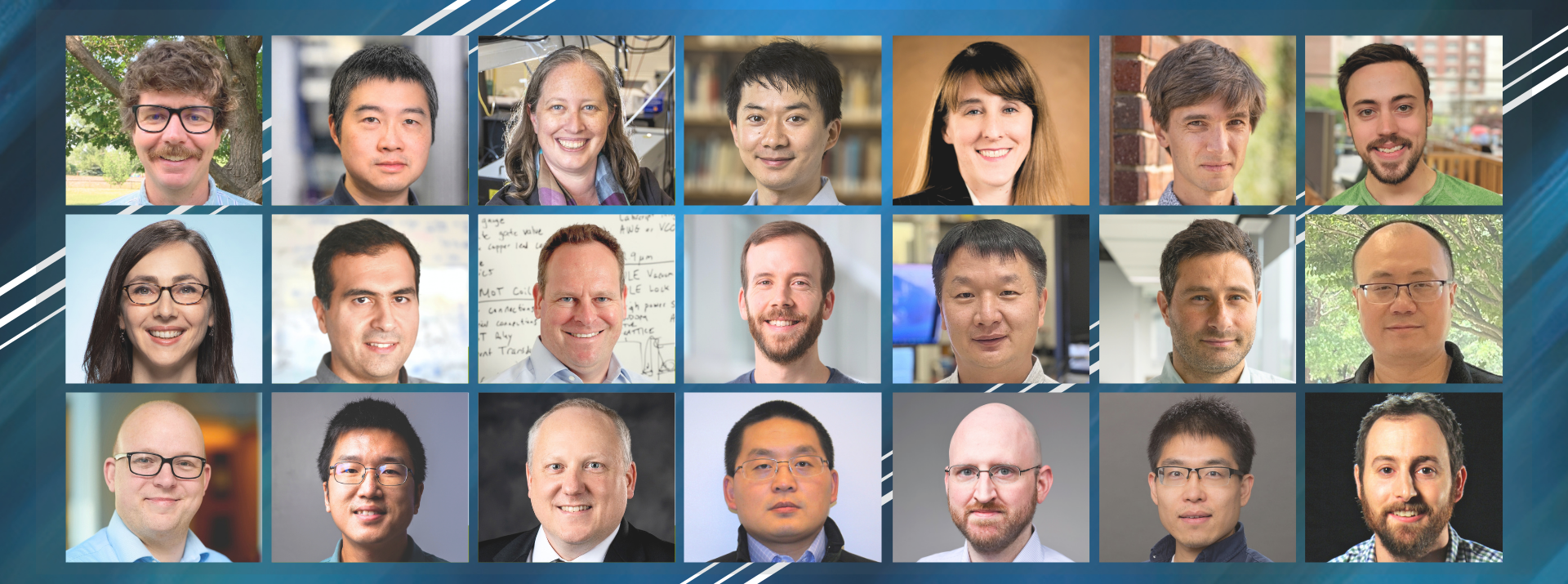
Meet the 2026 Experimental Physics Investigators
Samuel Brewer, Colorado State University.
Cui-Zu Chang, Pennsylvania State University.
Benjamin Crider, Mississippi State University.
Yongtao Cui, University of California, Riverside.
Luc Deike, Princeton University.
Susan Fullerton Shirey, University of Pittsburgh.
Elizabeth Goldschmidt, University of Illinois Urbana-Champaign.
Gabriele Grosso, City University of New York.
Dafei Jin, University of Notre Dame.
Maria Kamenetska, Boston University.
Jia I. A. Li, The University of Texas at Austin.
Bolin Liao, University of California, Santa Barbara.
Alireza Marandi, California Institute of Technology.
Peter McMahon, Cornell University.
David Moore, Yale University.
William Renninger, University of Rochester.
W. Benjamin Rogers, Brandeis University.
Dali Sun, North Carolina State University.
Sebastian Will, Columbia University.
Matthew Yankowitz, University of Washington.
Bo Zhen, University of Pennsylvania.

Message sent
Thank you for sharing.