The air in Belém felt heavy that morning, charged with the expectation of rain. We sat around a table with maps spread out between us, their edges beginning to curl with humidity. This was not a formal meeting of the United Nations Framework Convention on Climate Change conference, unfolding just a few miles away. It was a moment to listen to Indigenous leaders and their civil society allies from the Wayamu territory in the northern Brazilian Amazon. And in the weeks and months that followed that major moment for the Amazon, it was this quieter conversation I returned to, as I reflected on what it will take to protect the forest — not only through international commitments, but by aligning conservation with the long-term aspirations of the Indigenous communities who govern and steward these lands.
The leaders I spoke to had come to Belém from the Wayamu territory, part of a mosaic of Indigenous lands and protected areas that connect and protect vast tracts of Amazon forest north of the Amazon River, before it opens to the Atlantic Ocean. Wayamu in the Karib language is the name for the tortoise, an animal known for its persistence and resilience as it forges a steady path forward. Over the course of a decade, the Moore Foundation’s Andes-Amazon Initiative supported civil society and Indigenous-led efforts to protect this critical landscape, contributing to stronger governance and greater autonomy among Indigenous organizations and, in time, helping catalyze broader investment in the region.
Sitting together, Indigenous leaders traced their history across the maps of the Wayamu territory with quiet precision.
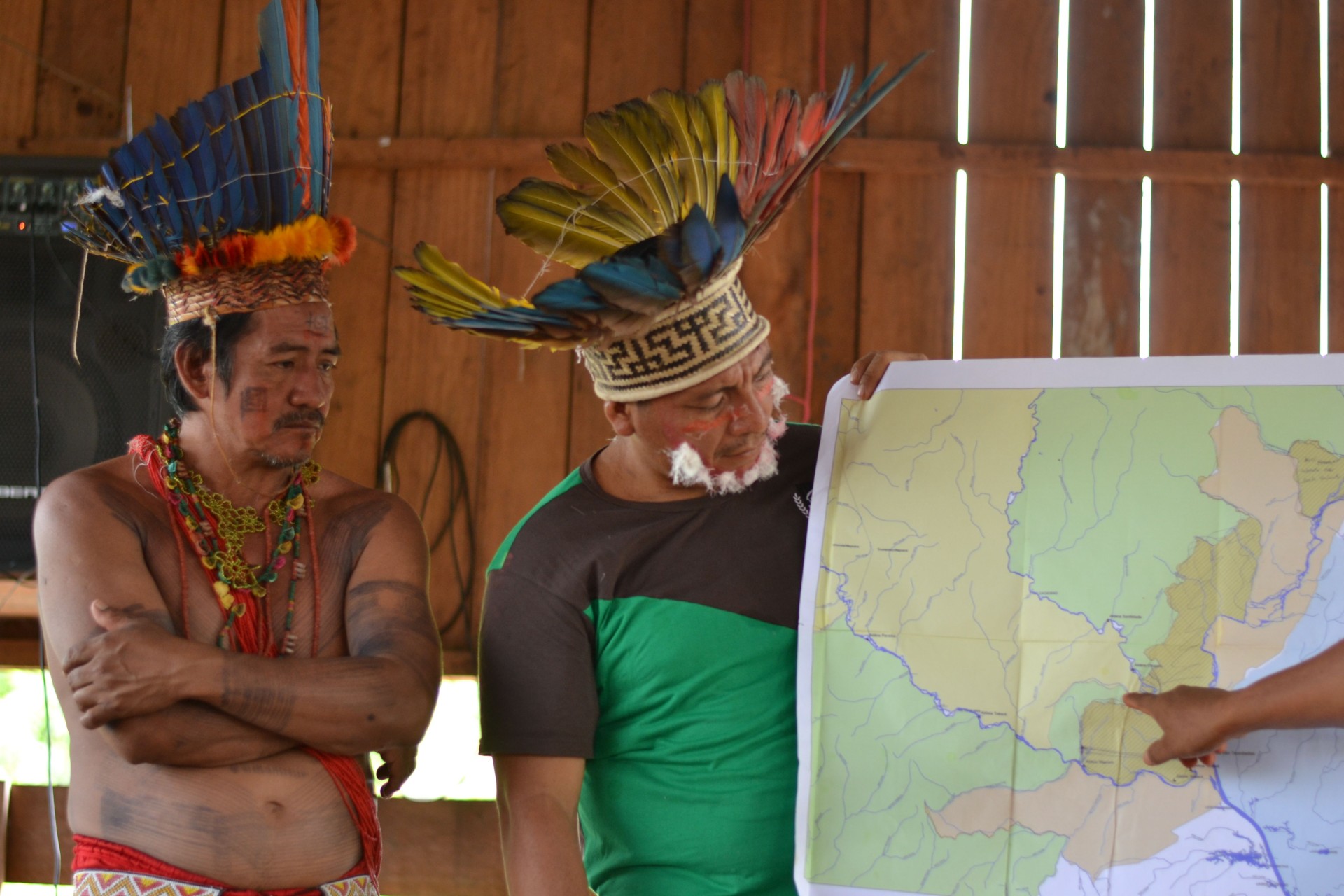 Indigenous leaders Juventino Kaxuyana and Lázaro Tunayana reflecting on their history across the maps of the Wayamu territory (2014). Credit: Ruben Caixeta.
One leader from the Kaxuyana-Tunayana territory, one of four Indigenous territories in the Wayamu, spoke of their forced displacement from their ancestral home along the affluents of the Trombetas river during Brazil’s military dictatorship. Rivers — the Cachorro, Mapuera, Nhamundá — became timelines, marking milestones in a decades-long struggle to return to their land. They spoke of building lives along other rivers further north, in the Tumucumaque Indigenous Park, creating new ties there. They spoke not only of belonging, but of responsibility for the lands and waters they knew intimately, and the interruption of practices that had sustained those places for generations during their time in exile. Their goal was to return home by securing the protection of these lands through formal legal recognition.
Recognition was not framed as a single battle or victory, but as decades of persistence — working with allies to secure a right protected under Brazil’s constitution. It was not the achievement of an abstract legal milestone. It was about the possibility of going home, and with it, the ability to once again govern, care for, and defend their territory. Listening to these leaders, I realized how inadequate our language in conservation and philanthropy is for outcomes measured not in years, but in generations.
Just a few days after this conversation, Brazilian President Luiz Inácio Lula da Silva would announce the final step of recognition of the Kaxuyana-Tunayana Indigenous territory as part of Brazil’s biggest advance in the recognition of Indigenous lands in over 20 years, drawing headlines and global attention. There is no doubt that these advances in territorial demarcation in Brazil are historic. The announcements represented milestone achievements across more than 30 Indigenous lands, advancing legal security and protection for millions of hectares of forest in the Amazon, and hard-won victories for communities and organizations.
Yet these moments of recognition and celebration are often just the most visible tip of a much longer process. They are the outcome of legal battles, organizational evolution, alliances forged between territorial associations and civil society organizations, and persistence across political cycles. In the stories and testimonies of the leaders and civil society allies sitting around that table, I could clearly see those processes at work.
Watching that moment in Belém surfaced a familiar tension for me, between achieving a desired outcome and the often-slower work required to get there. I have encountered this tension throughout my career and these experiences shape how I think about durable change. In particular, I am reminded of an important lesson learned years ago, when I was working on an initiative to bring sub-national governments into more structured engagement with Indigenous Peoples and local community organizations to devise joint solutions to climate change. The goal was not symbolic participation, but something more difficult: to agree on shared principles that would shape how governments and Indigenous and local community organizations collaborate.
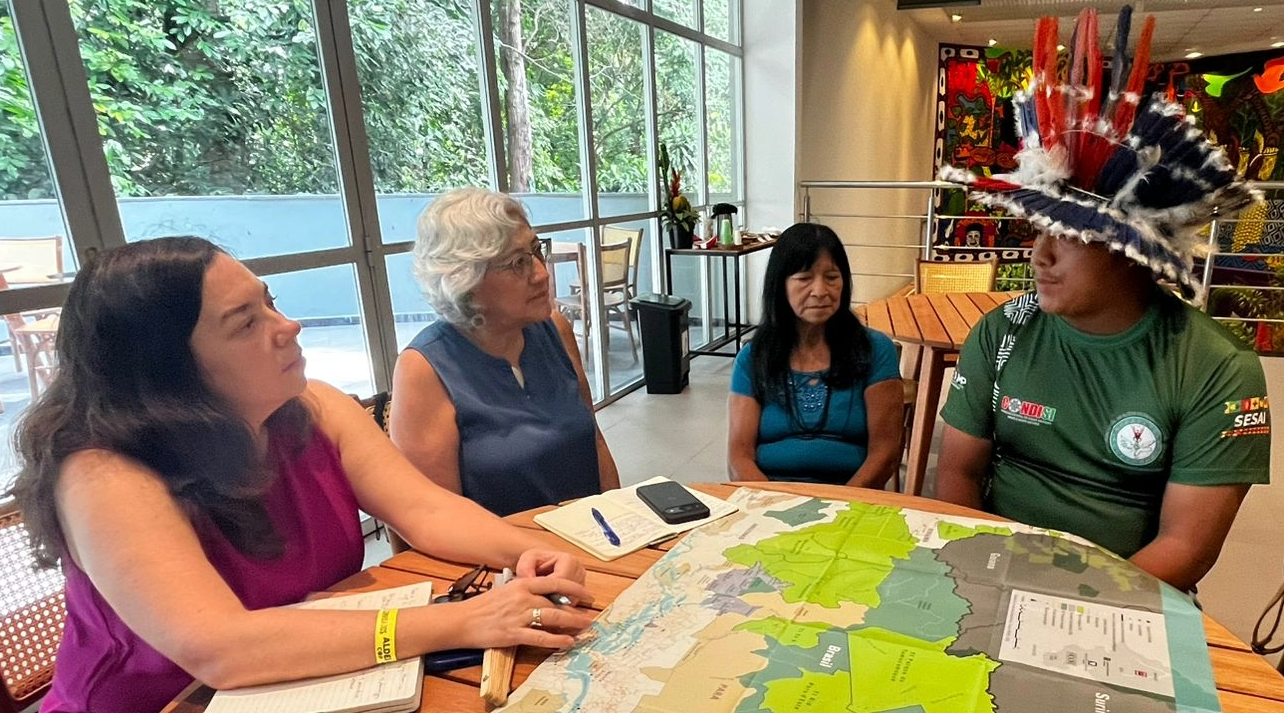 From left to right: Maria DiGiano, Avecita Chicchón, and Wayamu territory representatives Rosa Tiriyó and Aventino Tiriyó meeting in Belem. Credit: Luis Donisete.
The work was painstaking. Drafting language that reflected Indigenous priorities while remaining acceptable across jurisdictions required months of negotiation. By the time the principles were presented to decision-makers, there was a real sense of anticipation. We believed we had done the hard work needed to get this over the line. But we hadn’t. That year, the principles were not adopted. The moment passed, and with it the window we had hoped to seize.
Shortly afterward, I spoke with an Indigenous leader who had been closely involved in the process. Expecting commiseration, I was surprised by his response. He wasn’t disappointed.
Instead, he talked about what it meant to be in the room with governors at all, to sit across the table, to speak directly, to be recognized as a political actor rather than a stakeholder on the margins. He saw the process not as a failure, but as a step in a much longer journey.
That conversation stayed with me, revealing how much my own sense of progress was shaped by institutional timelines rather than by the slower arc of political presence and trust. His perspective reflected a different time horizon, shaped by generations of engagement with the state, where persistence itself is a form of power. Sitting at the table mattered, even when the decision did not go our way.
A year later, those principles were adopted. But the moment that changed me came earlier, as I grappled with feelings of disappointment and impatience, and later coming to a deeper understanding of how durable change actually happens. It doesn’t always happen in a linear way, but builds through sustained presence, repeated engagement, and a willingness to stay, even when progress is incremental and uneven.
That shift in how I understand progress is one of the reasons I am drawn to this work of supporting change-makers, and to an institution that values patience, persistence, and respect for complexity. From its earliest days, the Moore Foundation has been animated by a desire to make a meaningful, lasting impact and by a recognition that impact rarely comes from shortcuts. Whether in science or conservation, progress depends on a willingness to invest in complex systems, to work patiently through uncertainty, and to stay engaged when progress may be incremental or hard to see. In conservation, it means supporting the enabling conditions, such as governance, participation, and stewardship, that allow rights to translate into lasting protection on the ground.
When I think back to that table in Belém, with the maps spread out, the rain pressing in, the steady voices of leaders who had waited a lifetime to return home, I am reminded that the most important conservation work often happens long before it becomes visible. Recognition arrives in moments. Persistence is what allows those moments to endure. Persistence, I’ve learned, is not just something to admire in others. It is a value my work must embody, shaping how I show up as a funder and guiding how I support change when the work is slow, complex, and uncertain, much like the tortoise’s steady advance.
Maria DiGiano is a program officer for the Andes-Amazon Initiative at the Gordon and Betty Moore Foundation.

Message sent
Thank you for sharing.