2025 marked the Moore Foundation’s 25th anniversary. To commemorate this milestone, we launched a symposium series exploring topics related to the foundation’s mission. These events offer a chance to reflect on the progress of the past 25 years — and, as importantly, to envision the opportunities that lie ahead.
As part of the Gordon and Betty Moore Foundation’s 25th anniversary symposium series, staff from across the Bay Area's five largest science museums — California Academy of Sciences, Chabot Space & Science Museum, the Exploratorium, The Tech Interactive, and the Lawrence Hall of Science at University of California, Berkeley — gathered to explore how Bay Area museums can continue to engage communities with science in a rapidly changing world.
Celebrating a legacy of public engagement
The Moore Foundation has long supported Bay Area science and technology museums through its Bay Area Program as part of its broader commitment to provide opportunities to engage in productive, hands-on, science-rich learning experiences in out-of-school settings across the San Francisco Bay Area. These institutions play a critical role in connecting the public with science.
"Science museums provide spaces for dialogue on emerging issues, opportunities for scientists to engage with the public, and ways for people to more deeply understand the scientific process by doing hands-on science," reflected Jennifer Frazier, Program Officer at the Gordon and Betty Moore Foundation, in the event's opening remarks.
.jpg?sfvrsn=92cd630c_0&MaxWidth=800&MaxHeight=446&ScaleUp=false&Quality=High&Method=ResizeFitToAreaArguments&Signature=8FBFBB90A0F6F11295A31B4BC7D4AC19348A6A09 "Museums Reimagined welcome graphic notes")
Image: Graphic notes with key themes heard from participants and speakers during the welcome and panel discussion. Graphic artist, Alece Birnbaum.
Setting the stage: Why Bay Area museums matter
The Museums Reimagined symposium highlighted the increasingly important role museums can play in the current environment, where there is decreasing public trust in science, and complex science-related issues touching people's everyday lives.
Balancing celebration with collective problem-solving, participants were invited to reflect on both the opportunities, and the pressures museums face today — including shifts in public trust, evolving technologies, and financial and operational challenges.
Our founders, Gordon and Betty Moore, saw these institutions as tangible expressions of the values they cared about – curiosity, discovery, and a deep appreciation for the natural world. With deep ties to the Bay Area, they believed that museums play an essential role in helping people understand science. That vision continues to guide the foundation’s commitment to strengthening the region’s science museums and supporting their work with communities across the Bay Area.
The Bay Area’s unique ecosystem
To set context for the day's discussions, regional museum leaders Erica Barrueto, Rena Dorph, and Robert Semper reflected on the unique ecosystem in which Bay Area science museums operate: the region’s long history of scientific innovation, its world-class universities, technology sector, and a culture of community organizing create conditions that make experimentation and collaboration possible.
Panelists shared how the region’s communities support the work of museums. They described a culture in which museums regularly learn from one another, seek advice across institutions, and build on the region’s collective strengths. They also reflected on how the Bay Area’s values — creativity, curiosity and civic engagement — shape their missions and help sustain their work.
Speakers also focused on how flexible, out of school learning spaces where technologists, scientists, and communities come together can support "third millennium thinking," needed to address the challenges society faces today. They encouraged participants to go into the day's discussions with this future thinking in mind, and to think about what might be possible when acting collectively.
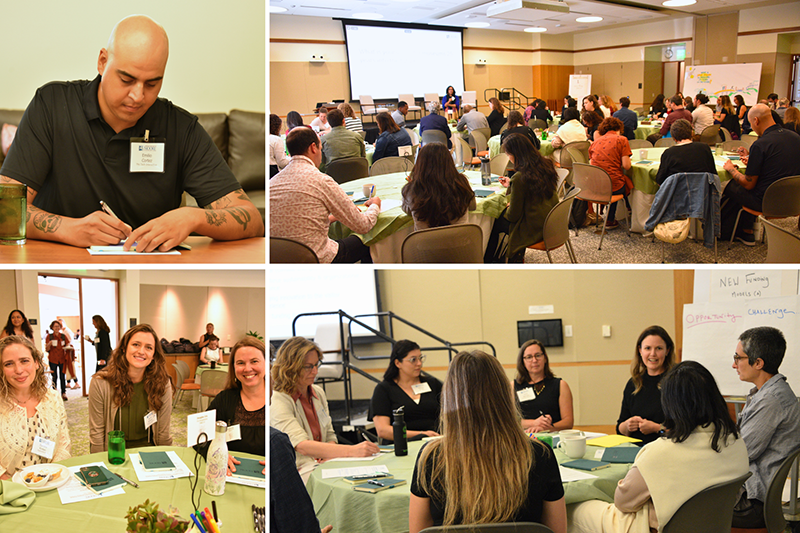
Image: Attendees engaged in discussions and in sharing of ideas and experiences for actionable solutions.
Exploring new models for collaboration and connection
The focus of the event were the breakout sessions on topics that participants had identified as key to the future of museums, such as community engagement, public trust, new funding models and the use of AI.
Key themes:
- Collaborating across institutions. Participants proposed regional partnerships such as a shared “science passport” program, cross-institution data collection, and coordinated advocacy for public funding to keep museums accessible to all.
- Engaging communities in new ways. While Bay Area museums have long pioneered new ways to engage with communities, participants discussed that in the current environment new strategies are needed that open up dialogue across divides and foster question asking and critical thinking.
- Innovating the visitor experience. Participants explored how emerging technologies — including artificial intelligence — could enhance accessibility and real-time learning, while emphasizing the importance of ethical and transparent use of this technology.
In addition to these themes, two priority areas were surfaced through a post-conference survey of participants and analysis of the day's discussions:
Building and sustaining trust in science
A central theme of Museums Reimagined was how museums can help strengthen public trust in science at a time when misinformation and polarization often shape public discourse.
Museum partners noted that trust grows when visitors see science as relevant to their everyday lives and when museums reflect the communities they serve. Discussions emphasized the value of showing how scientific understanding evolves, modeling curiosity, and creating space for dialogue rather than certainty.
As one attendee observed, “Science museums can remind us that science is not about having all the answers — it’s about asking better questions.”
Making museums relevant and welcoming to all communities
Beyond programming, the symposium explored the need for new approaches to engaging people that aren't currently coming to museums. These included continuing to build on pioneering regional work to make museums more relevant and welcoming to communities that typically don't see museums as "spaces for them." It also included ensuring that museums do not become polarized spaces, where only one point of view is welcome. Breakout groups on audiences and innovation also focused on how technology could be used to create personalized, immersive, or other novel spaces that are competitive in an increasingly crowded landscape for people's attention.
These ideas reflect a shared commitment to ensuring museums remain vital, equitable spaces for learning — no matter how audiences, technologies and funding landscapes evolve.
Looking ahead
Building on the Moore Foundation’s 25 years of past commitment, the final session of the Museums Reimagined symposium returned the day’s discussions to the central question: how can Bay Area science and technology museums continue to serve as essential civic spaces for discovery, dialogue, and innovation in a rapidly changing world?
In closing reflections, Adam Tobin, then Executive Director of the Chabot Space and Science Center, urged a renewed commitment to reinvention. He emphasized that some of the rationales that once justified the creation of science centers still hold, while others must evolve. The moment, he said, demands renewed willingness to question long-held assumptions about what science museums are for and how they operate. The need for what they provide — spaces for public engagement with science — has never been greater.
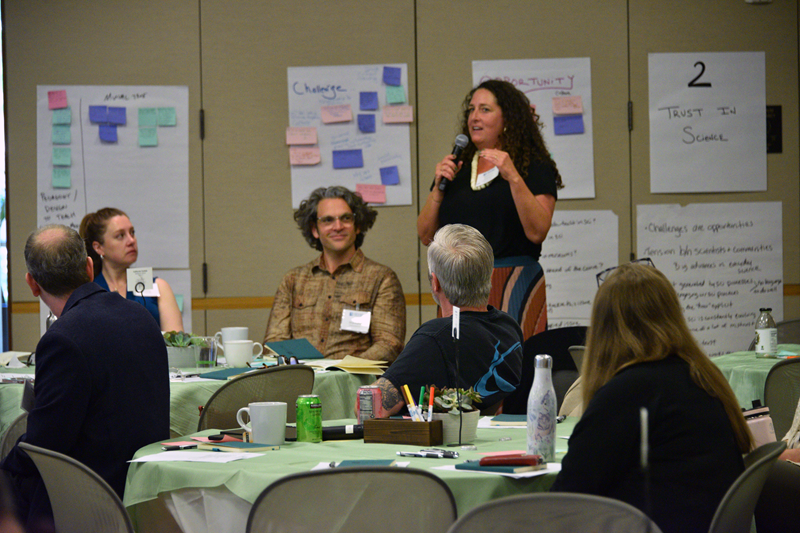
Image: Rebecca Johnson, Director of the Center for Biodiversity and Community Science at the California Academy of Sciences
Rebecca Johnson, Director of the Center for Biodiversity and Community Science at the California Academy of Sciences, continued that thread of community. She likened the Bay Area museums to a team with “different superpowers,” whose combined effort could achieve what none could do alone. In the face of global uncertainty and external pressures, she suggested that the most resilient path forward may be the local one — rooted in regional cooperation and shared purpose.
"The world outside is changing fast and often feels chaotic. The best response may be local and regional — by strengthening our connections with each other and building on what’s already here."
At the event's close, Janet Coffey, Program Director at the Gordon and Betty Moore Foundation, linked the day's discussion back to the founding vision of Gordon and Betty Moore.
"25 years ago, Gordon and Betty Moore established this foundation to benefit future generations. The work you and your colleagues do every day — at your museums and in your communities — is central to realizing that vision. It’s inspiring to see how you transform challenges into opportunities with creativity and pragmatism. That spirit was evident throughout the day, and it gives me great optimism for the future. I look forward to continuing to learn and work together in the years ahead."
Related stories in the 25th anniversary symposium series

Message sent
Thank you for sharing.