Every scientific advance begins with an individual journey: a question that won’t let go, a moment when persistence pays off, a new way of seeing an old problem.
One way the Moore Foundation’s Science Program supports these moments is through funding individual research efforts outside of major initiatives. This grantmaking approach allows the Foundation to nimbly fund work that is high risk, ambitious, and sometimes deliberately unconventional. In this space, researchers are encouraged to take intellectual leaps and explore novel approaches to push forward the leading edge of discovery.
While these projects often begin as individual journeys, no story of discovery unfolds in isolation. To foster interdisciplinary connections, exploratory discussion, and a sense of community, the Moore Foundation relies on the power of convenings.
Over the past three years, the Quantum Imaging, Sensing, and Metrology convenings have brought together a wide range of Moore Foundation science grantees. These projects are intentionally independent, yet they share a common goal: leveraging quantum physics to deepen our understanding of living systems.
Breadth as a catalyst for discovery
This grantee community is intentionally broad. Physicists developing electron-based imaging tools engage with biologists studying molecular processes in cells, alongside theorists probing quantum coherence and engineers designing new sensing platforms. Many of the most compelling ideas discussed at the convening emerged from simple exchanges across fields.
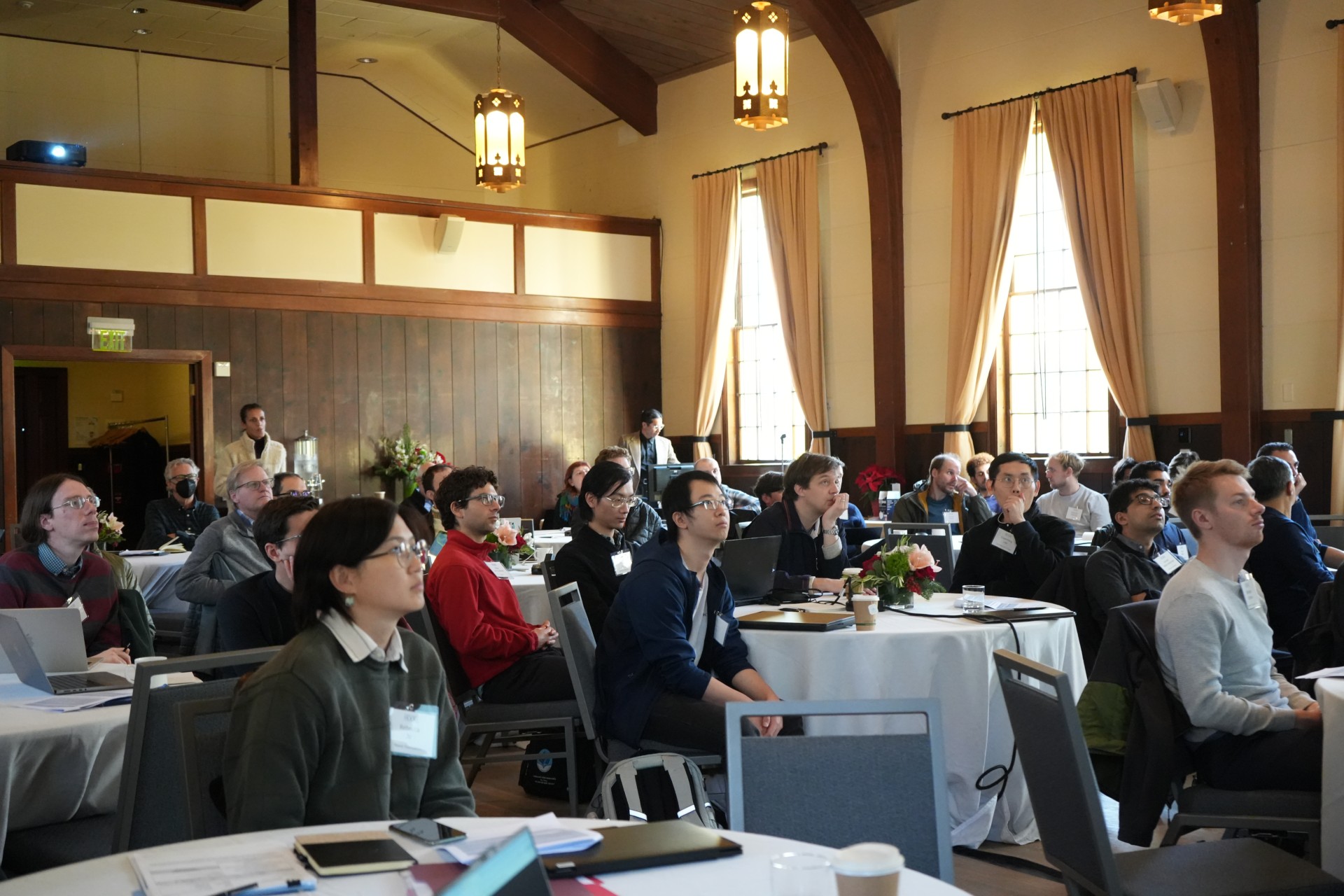 Attendees at a presentation during the 2025 convening.
Zhaowei Liu, a principal investigator developing novel imaging methods for hydration shells, recalls being the lone engineer in a room full of biologists. He posed a straightforward question: If water is so important, why don’t you study it more directly? The answer was equally simple: We don’t have the tools.
The biannual structure of the convenings creates repeated opportunities for researchers to engage with colleagues outside their home disciplines, allowing ideas and relationships to develop over time. After connecting at the first convening, Mohammed Hassan and Moh El-Naggar's groups began collaborating, with El-Naggar’s lab providing cable bacteria samples as biological systems for Hassan’s ultrafast electron transport research. Two years later, they returned to present the first results from their joint experiment.
The convening also reflects breadth across career stages. Students, postdocs, early-career investigators, and field veterans share tables, present lightning talks, and engage in discussion on equal footing. This intergenerational mix brings fresh perspectives into conversation with deep experience, reinforcing a culture where ideas are free-flowing and questions are always welcome.
A sandbox for exploration
Grantees at the convening expressed appreciation for the freedom offered by the Moore Foundation’s funding model. Though these projects share an overarching trajectory, their independence allows each research team to tackle a novel and distinct question. Complementing the more structured, long-term focus of Moore Foundation Initiatives, this approach creates room for researchers to venture into new directions as the science evolves.
This freedom fosters a sense of play — where creativity is not only allowed, but essential for accelerating progress. At the same time, the work remains oriented around a shared north star: relevance to biological understanding. The result is a constellation of new approaches, including novel imaging modalities, sensing strategies, and experimental frameworks that collectively expand what is possible.
One hallmark example of this creative freedom is Mark Kasevich’s work on quantum electron microscopy, a bold and ambitious effort that pushes the boundaries of both engineering and physics. By introducing quantum control of the electron source, the Kasevich group aims to image biological samples in a way that preserves information while dramatically reducing damage.
This explorative mindset can yield innovation not only through new technologies, but also through new ways of thinking. Mert Yuksel, a postdoctoral researcher in the Roukes Lab, presented a particularly compelling experiment that, in principle, could have been performed decades ago. What made it new was not the technology itself, but the creative reimagining of what existing methods could do — a reminder that breakthroughs often emerge from fresh perspective as much as from new innovation.
Science as a story sustained by trust
A unique addition to the 2025 convening was a keynote address and early-career workshop led by award-winning science journalist Miles O’Brien, which invited participants to reflect on their roles in telling the story of science. O’Brien urged attendees to view themselves as narrators of their own stories, stating that “Some of the best science communication today is coming directly from scientists themselves.”
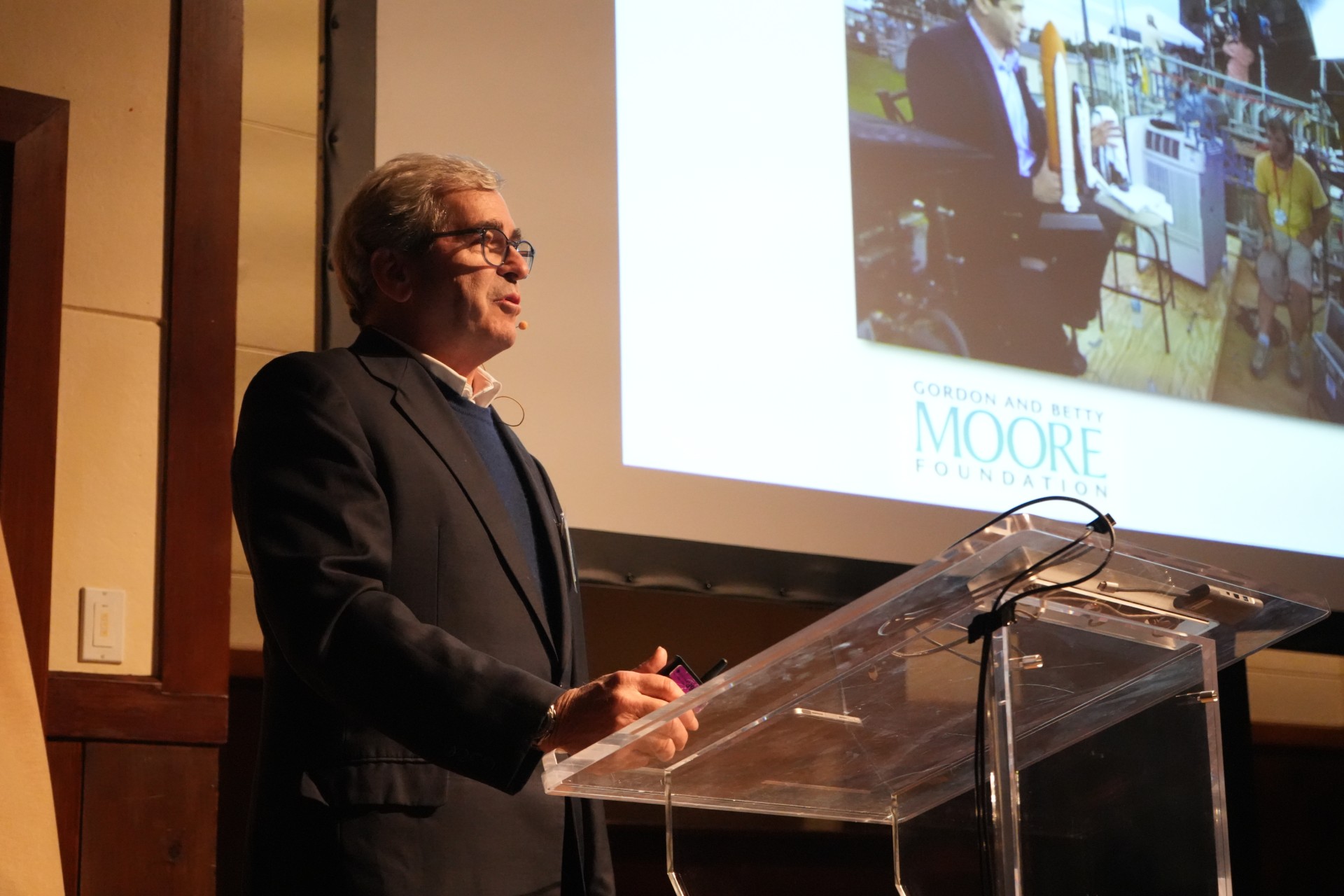 Miles O'Brien speaking during the keynote address.
In a field as technically challenging as quantum physics, both scientists and communicators often struggle with the task of bridging the gap between the research and the real world. However, O’Brien’s sessions created space for open, face-to-face conversation, allowing participants to explore how their work is driven by deeply human motivations — curiosity, persistence, and the drive to explore the unseen.
As conversations unfolded, a core thread emerged across the myriad projects presented. Though the research focuses on fundamental scientific discovery, it also lays the groundwork for future advancements with real human impact — from less invasive medical imaging to more efficient solar cells. Understanding this long horizon of discovery, O’Brien pondered whether the challenge had been framed incorrectly. The task, he realized, might not be to explain every detail of the physics, but to reveal the human pursuit behind it. “In the end,” O’Brien reflected, “it’s not about explaining the science — it’s about connecting with people.”
In many ways, that spirit mirrors the purpose of these convenings. Individual journeys spark discovery, but it is through shared space — grounded in trust, curiosity and creative freedom — that those discoveries gather momentum. By supporting both the independence of researchers and the connections among them, Moore Foundation funding aims to help bold ideas move beyond isolated sparks and become part of a broader, collective advance in understanding the world around us.
Rebecca Ju is a program associate for the Gordon and Betty Moore Foundation's Science Program.

Message sent
Thank you for sharing.