Dr. Hussam Mahmoud is the Craig E. Philip Endowed Chair of Engineering, the director of the Vanderbilt Center for Sustainability, Energy, and Climate, and a professor in the Department of Civil and Environmental Engineering at Vanderbilt University. He is a leader in wildfire resilience and community hazard modeling, with notable success in validating his models on real-world fires, and the Moore Foundation’s Wildfire Resilience Initiative has supported his work on graph theory for wildfire behavior modeling in the built environment of the wildland-urban interface. He has been recognized for his work in numerous ways, including recently being selected as an Icon of Change in the United States and a National Geographic Explorer.
In this edition of Beyond the Lab, Hussam dives into the value of interdisciplinary research and how his sense of curiosity led him to where he is today.
What made you want to become a researcher in the first place?
When I came to the United States to do my undergraduate degree at the University of Minnesota, the idea was to finish and go back home. I was not interested in staying, but while I was studying there, I realized that so many things piqued my curiosity. It led me to look into strange subjects or topics that I did not know anything about. I was so curious that I would find any interesting presentation and go to it, even if I was new to the topic.
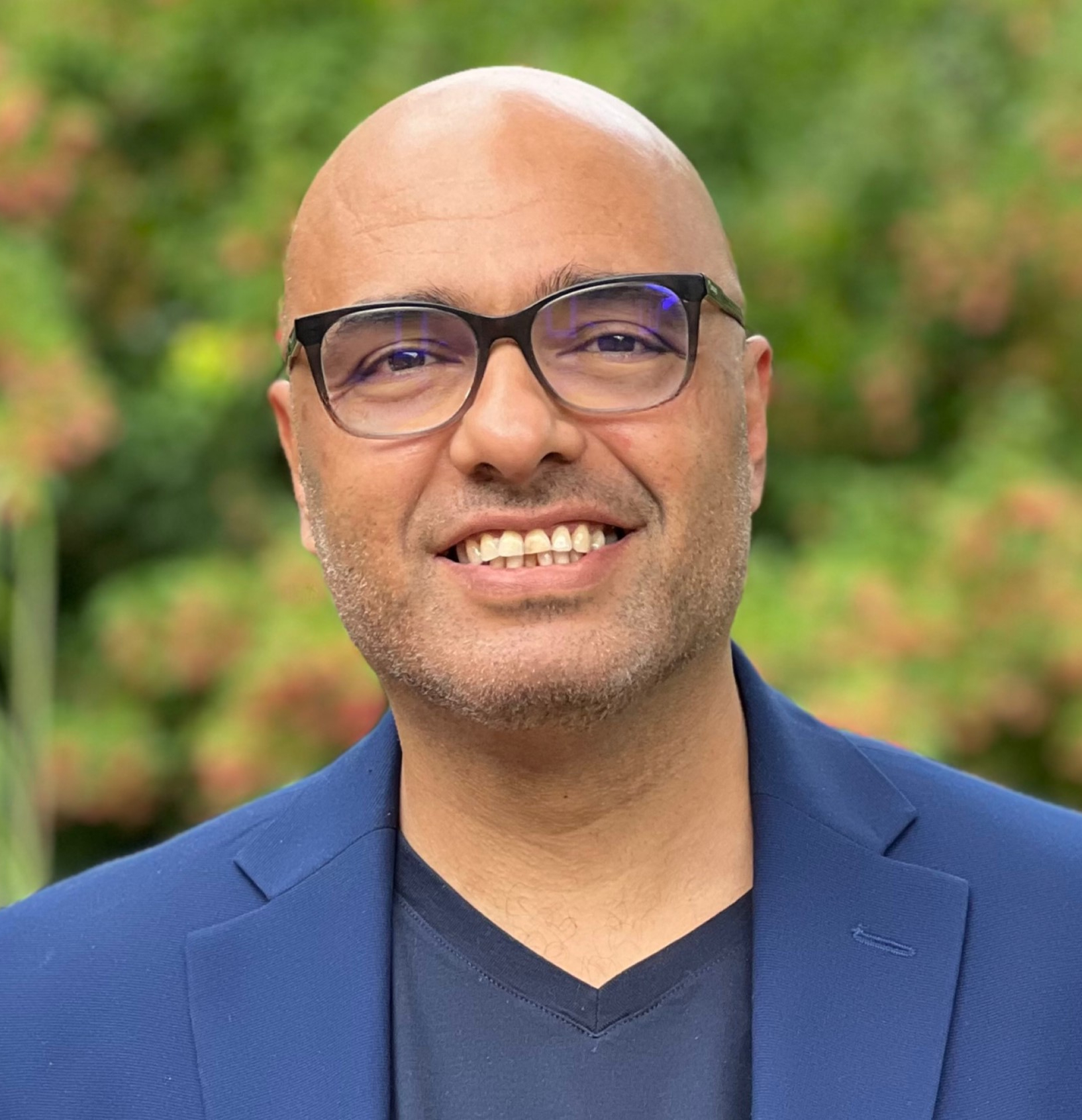 Hussam Mahmoud.
The hilarious part is, since my English skills were not good at the time, I would go to these presentations and have no idea what people were saying – 80-90% of what they were talking about would just go over my head! I was still so excited to learn, and I quickly realized that I just loved the idea of exploring new things. I like that research gives you the opportunity to remove divisions or constraints and simply think freely.
What are some of your sources of inspiration?
I was fortunate to have professors who recognized that I could do well in research – I’ve always gotten good feedback from my mentors and advisors, it was encouraging and it was a major factor in deciding to continue my education and not go back home after finishing my undergraduate degree. They gave me amazing opportunities to go pursue whatever I wanted, to explore things the way I wanted to explore.
In simple terms, how would you describe the problems you and your colleagues are trying to solve right now?
In general, I am intrigued by problems that lend themselves to complex system analysis and demand that we examine them from new angles. From the wildfire perspective, there are plenty of complicated problems to work on. I started looking at things related to wildfire damage to communities and how to model that complex propagation of fire within them, and now we're looking at layering wildfire damage with ecosystem services, ecosystem health, and the lumber supply chain. The system-level behavior and system-level analysis makes it very intriguing to work on.
What are some of the biggest challenges you’ve faced over your career?
I was fortunate to go to school at very strong universities – I did my undergraduate and Masters degrees at the University of Minnesota and my Ph.D. at the University of Illinois at Urbana-Champaign. Things were going great, but I worked in an area that did not necessarily have a lot of funding available for my research, and at the time there were some preset and predetermined notions of where the money would go. I felt a bit constrained and at a disadvantage, so I had to pivot to find opportunities to make significant contributions. I was able to find a way to go from purely structural engineering to looking at new areas including the impact of wildfires, COVID-19 transmission, and healthcare systems and healthcare resilience.
Sometimes researchers can work on a specific topic for their Ph.D. degree and get funding and momentum in that area relatively quickly as young faculty. That was not the case for me, so I had to adjust.
What have been some of the most fulfilling moments?
I have three things. First, on the research side, when we came up with the AGNI-NAR model and seeing people appreciate what it could do and help with, it was fulfilling because it makes you feel, “Well now I’ve done something useful!”
I have also done quite a bit of work with the United States Army Corps of Engineers on repairing infrastructure and it’s been great to see those repair techniques applied to many existing structures.
Finally, I have been incredibly fortunate to be heavily immersed in activities with the National Academies of Science, Engineering, and Medicine to the point where I have been able to provide input on internal programs and lead some symposia and workshops. The National Academies gave me the opportunity to serve, help mentor younger faculty and to grow my career in a way I never imagined. It’s also been incredible to collaborate with international partners through the National Academies.
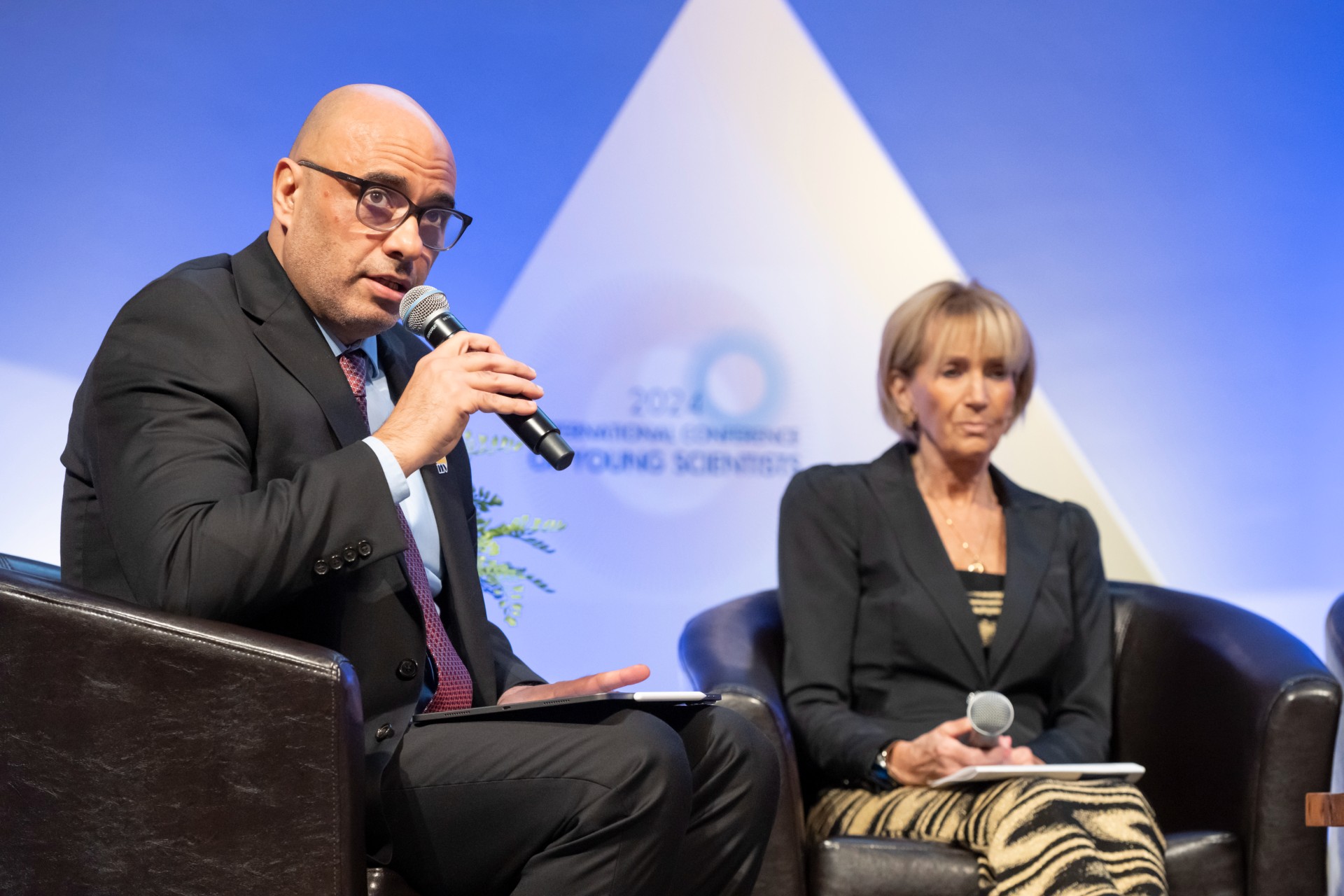 Hussam at the 2024 International Conference of Young Scientists with Dr. Marcia McNutt. Credit: National Academies of Sciences, Engineering, and Medicine New Voices Program.
Is there any advice that you pass on to students or young researchers?
The first thing I do – and my students actually laugh about it – is I give them complete ownership of the project. If a student, researcher or postdoc comes to me and asks me a question, the first thing I say is, “Well, I have no clue what we should do. It's your project. What do you think?”
Of course, I help make sure the work gets done, but through that ownership I want them to feel like they’re completely invested in ensuring the project is successful and that they get credit for the work.
I also want them to know that the sky is the limit. Do not put boundaries between you and any other topic that you might want to work on. Do not constrain yourself and say, “I'm only trained as a structural engineer, therefore I only work on structural engineering.” In my opinion, that does not produce good researchers.
Can you speak more about the value of interdisciplinary research?
The most challenging and complex problems that we face right now are interdisciplinary in nature. They cannot be solved by a single group or a single entity.
For a simple example, we can talk about natural hazards and the impact that they have on societies. They affect public health, so you need people that know public health from different angles, such as doctors, social scientists and people that work in government. You need people that understand structural behavior. You may need people that are good at computer science because you might want to develop AI models or digital twins as a decision-making tool.
You need all these disciplines together. That’s what excited me about this opportunity at Vanderbilt’s Center for Sustainability, Energy, and Climate. How can you bring people together to solve the most complex and the most pressing problems in energy integration and transition, sustainability and resources, and the issues related to climate resilience and the impact of natural hazards on our society?
I don’t think we can tackle these complicated problems without emphasizing interdisciplinary research.
Where do you see yourself or your research in five years, either personally or professionally?
I’d like to see our group continue to tackle challenging problems. Our research is going well and there are exciting problems that we work on every day, so I'm not worried about that. Aside from that, I'd like to see myself be able to facilitate more of that interdisciplinary research across Vanderbilt and outside of the campus. I’m relatively new at Vanderbilt, and it's important that I’m able to fulfill the goal that brought me here. Can I bring people together and engage with all these wonderful researchers across the country?
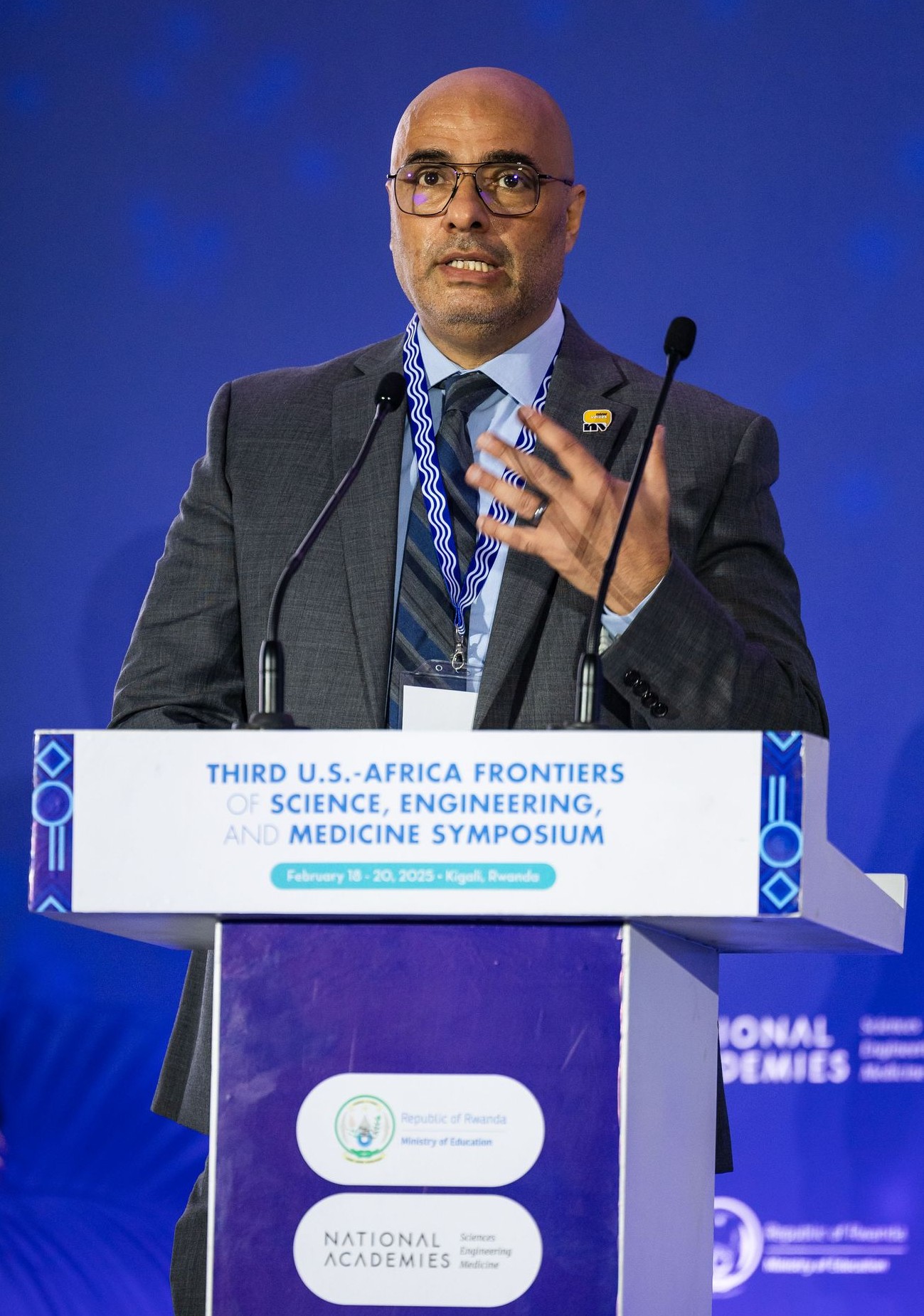 Hussam speaking at the third U.S.-Africa NASEM Frontiers of Science, Engineering, and Medicine Symposium, in Kigali, Rwanda in 2025. The U.S.-Africa program brings together outstanding young scientists, engineers, and medical professionals from the United States and the member countries of the African Union for a series of symposia to discuss exciting advances and opportunities in their fields. Credit: National Academies of Sciences, Engineering, and Medicine New Voices Program.
The other thing is inspiring younger generations and the idea of mentorship. I recently talked to one of my good friends about this – I'm at a point in my career where I feel like this gives me purpose. I would love to be able to say we developed a more systematic way of engagement – as opposed to the more ad hoc style right now – that can inspire and maybe excite thousands from the postdoc level on down.
How can I get them engaged and how can I mentor the new generation? I want them to think that everything is possible.
What are some of your hobbies or interests outside of work?
I came to the United States in 1997 for undergrad, so I have lived in America longer than I lived in Egypt, but I embrace both cultures. I make it a point to go back home as much as I can to visit family and friends. I like to engage with the culture and that keeps me going even when I'm not traveling there. Arabic is my native language and I love Arabic poetry, literature and music, so I write my own poetry and play the lute. I also work out as much as I can!
Is there anything else you’d like to share?
I’d like to highlight three organizations that had substantial impact on my career: the United States Army Corps of Engineers, the Moore Foundation and the National Academies of Science, Engineering, and Medicine. My experience with the Moore Foundation and National Academies was notable because I was supported on multiple levels in addition to funding.
In the future, I would love to see similar models in academia that could support younger faculty, such as assistant professors, on a deeper level. I wonder how much talent we lose due to a lack of support – it would make such a difference in their careers and make the path easier. I’m happy with where I am now, but it was difficult – I had to pivot and maneuver along the way. Still, those experiences shaped me, and they reinforce my commitment to helping build a more supportive and sustainable environment for the next generation.

Message sent
Thank you for sharing.