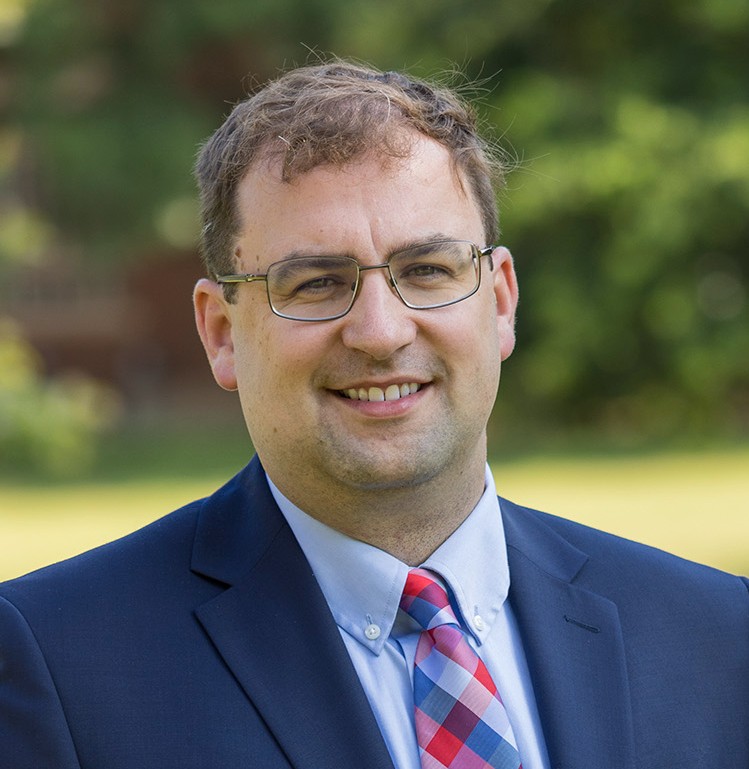
Brian Elbing is a Professor of Mechanical and Aerospace Engineering at Oklahoma State University and a Moore Foundation Experimental Physics Investigator. His research focuses on the identification of fluid mechanisms in complex high-Reynolds number flows with an emphasis on flow control, flow-induced acoustics, and atmospheric turbulence. Through our Experimental Physics Investigators Initiative, the foundation has supported his work on identifying the fluid mechanism responsible for tornado-generated infrasound and using this understanding to improve tornado warning processes in regions with hilly terrain. You can learn more about his work on his lab website and YouTube channel.
In this edition of Beyond the Lab, Brian discusses his journey as a researcher and shares some of his goals for the future.
What made you want to become a researcher in the first place?
The short answer is that I really like to know what's true, and at an early age, I started asking and thinking about how you figure out whether something's true.
Combining that with my love for problem-solving led me in a scientific direction. When I got into college, I was split between mathematics and engineering, and I chose engineering because I like having a practical side to my work. But I picked fluid mechanics because there were endless problems and questions, and the more I looked at it, the more I realized how little we really know about how it really works.
I really wasn't planning on doing research until my junior year of college. I was asked by a professor, Dr. Hosung Lee, to work in his lab, and I immediately realized that research was so exciting. I loved it and decided that I had to go to graduate school because I needed more experience to be a researcher.
I started looking into switching universities to gain exposure to more opportunities. I got into the University of Michigan around the same time I landed an internship at NASA, where Allan Zuckerwar shaped much of my career. I did acoustics with him, and then during my Ph.D., I worked with Dave Dowling, Steve Ceccio, and Mark Perlin. They really filled out my background in experimental fluid mechanics. Those four individuals heavily shaped me, and I’m thankful for all of them. I like fluid mechanics because almost everything on Earth involves it, so I can pretty much pick whatever problem I want to work on and then find the application or connection.
As you’ve progressed through your career, what have been some of your sources of inspiration throughout your journey? What keeps you going?
The first big one that shaped me a lot was identifying drag reduction techniques for Navy ships during my Ph.D. work. I was working with Eric Winkel, another grad student, and we were funded by DARPA to look into two technologies: one involving a water-soluble polymer and the other focused on air injection to create bubbles to modify momentum and reduce drag.
The air injection results were not very promising, except for these unusual cases in which we achieved 100% drag reduction across our entire 45-foot-long plate. We found that very interesting, but the leadership at DARPA at the time told us not to pursue it because it was an air layer and not bubble drag reduction. We ran more experiments and eventually wrote the first paper on air-layer drag reduction. These days, companies in countries like Japan and Denmark are leveraging that knowledge and showing fuel savings on ships.
How would you describe the types of problems that you and your colleagues are most focused on solving right now?
Right now, my work is split into two parts that are somewhat related. Over the last handful of years, I've gotten involved in high-altitude ballooning (flying about twice the height of an airplane) in collaboration with NASA and Sandia National Laboratories. Our department has a lot of experience with launching and flying things, I have expertise on infrasound, or low-frequency sound, and they wanted to measure small, weak earthquakes. They want to see if you can infer the structure of Venus from flying sensors in Venus’ atmosphere and getting high-quality sensor data at altitude.
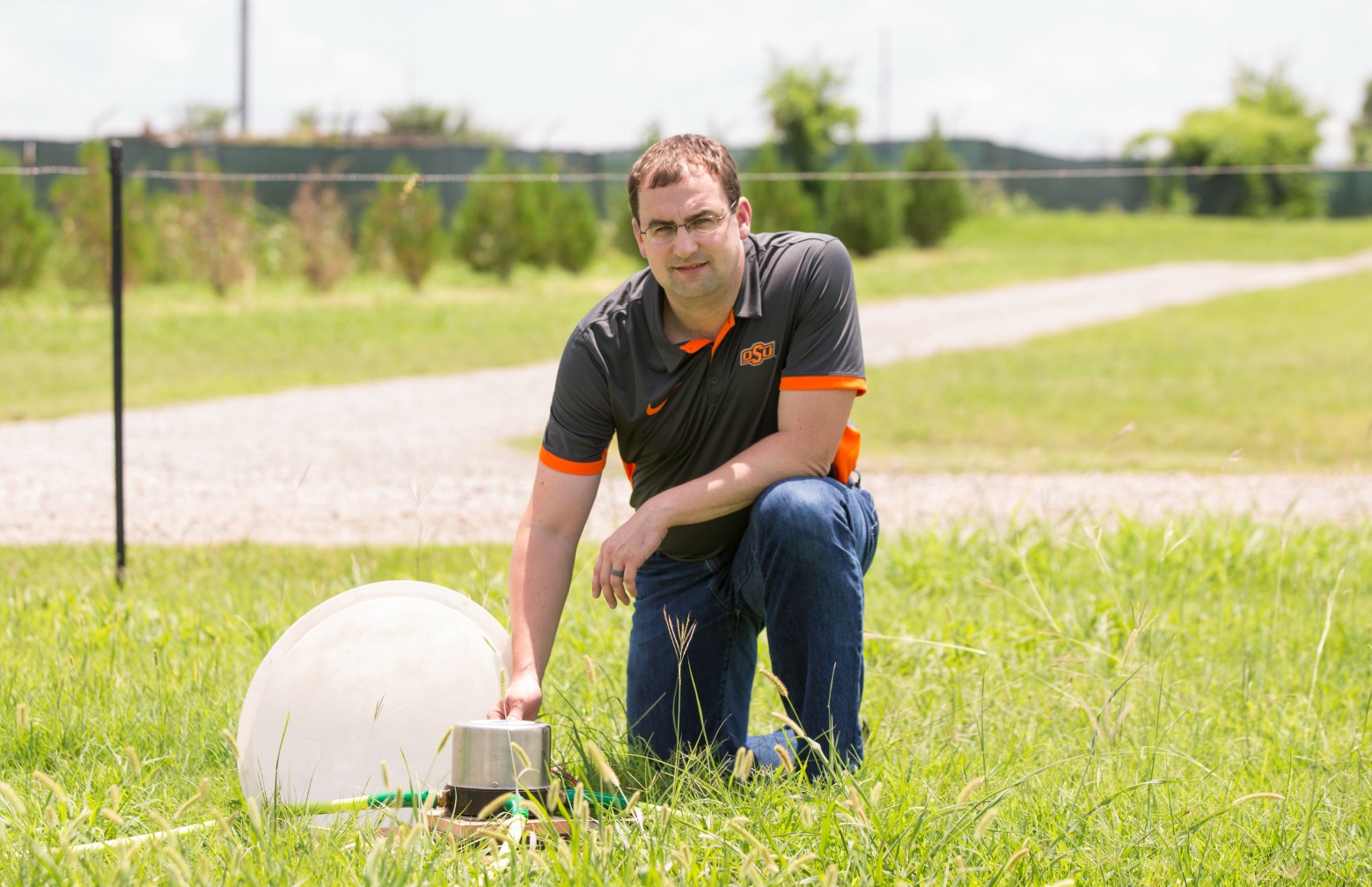
This connects closely to the other side, which is infrasound from tornadoes, and the effort to identify the fluid mechanism that produces that sound. My NASA mentor, Allan Zuckerwar, saw that I had moved to Oklahoma and called me to say, “Hey, I've always wanted to measure the sound from a tornado.” Initially, I said, “I'm not really doing acoustics; that doesn't sound like a direction for me.”
However, he piqued my interest enough that I spent a couple of years reading about it and really delved into the details. The more I looked at it, the more I realized that Dixie Alley (the southeast U.S.) with hilly terrain really limits both radar (because it's a line-of-sight measurement) and storm chasers, who don't want to chase where there are dead ends.
This means there is a need to find some other technology that can supplement weather radar. Looking forward, if we can identify the signature and a processing scheme that could pull the signal out in real time, you could have an alarm that goes off when it detects a forming tornado. It could help people take cover, even at the last minute, and save many lives.
What advice do you give students or young researchers?
When I got my Ph.D., my initial intent was to work for a government lab. I really liked researching and solving problems, but as I finished my Ph.D., I started shifting my focus. I didn’t want the work to end with me. I wanted not only to conduct research but also to prepare the next generation of researchers.
At that point, you become a professor. Working with young researchers helps keep you fresh. Students bring energy and curiosity; it's so fun and enjoyable. I feel like I have to bring the energy too, because I can't be the one who's holding them back. It breathes new life into projects.
Often, the things we talk about are the very end of the process. Usually, the more satisfying that point is, the more difficult it is in between. I really encourage students to get comfortable with feeling that discomfort, to sit with it and be resilient. The more you're willing to sit in that space, the more rewarding the finish line is because you’re able to go deeper and learn more.
When I was going to grad school, an advisor told me to get comfortable with being uncomfortable. The longer I've been doing this, the more I think that is the best advice.
Where do you see your work in five years?
For my Moore Foundation-funded work, we’ve been pretty successful in confirming some of our hypotheses about what's contributing to the sound, and we've made a step forward in isolating the contributions from the tornado.
What we still lack is getting radar data from close to a tornado. I think what people don't realize is that when you look at a weather radar on a newscast, it’s so far away that the tornado can't be seen. What we really need are radar and infrasound sensors close to a tornado, so we can obtain a reliable signature of the flow field and acoustics.
In the next five years, solidifying that piece is key, and once that's done, deploying arrays, particularly in the southeast United States, and setting up a network. Getting the signature identified more clearly is an achievable goal, and, if that's successful, the next step would be exploring how this could support NOAA operations and commercial applications.
Have you had any dangerous field experiences with tornadoes?
No, I've never chased – I’ve never seen a tornado in person! We partner with Val Castor, a storm chaser, and he's carried microphones for us. I was supposed to go out with him a few years ago, but there were some complications, and we haven't been able to arrange it since. I have to go at some point, because I’ll feel like a fraud if I never see a tornado! Maybe it’s in the cards during these next five years.
What are some of your hobbies when you’re not working?
I have two little kids, so I give most of my time to them. We work out a lot as a family, and we go to the gym regularly. We also go to football games, basketball games, church events, and anything else that fills up our spare time.
What are some of the most memorable places that you’ve traveled to or spent time in?
Memphis, Tennessee, is special to me because I've spent a lot of time there – it’s the closest place to home that I haven’t officially lived. There’s a place called the Large Cavitation Channel, which is the world’s largest water tunnel, and it’s where nearly all the data for my Ph.D. was collected. I ran some of the longest experiments in the history of this facility.
Is there anything else you’d like to share?
I'm thankful for the support – it’s hard to express how much more fun research has been with the flexibility and resources provided to us.
Image credit: Phil Shockley/OSU

Message sent
Thank you for sharing.