Across wildfire-prone communities in Western North America, homeowners increasingly understand that wildfire poses a risk to their homes and neighborhoods. The hardest part of this challenge is turning that awareness into action.
As part of our Wildfire Resilience Initiative, we partnered with RALLY to better understand the key question: If homeowners already understand that wildfire is a threat, what would move them to take the steps needed to make their homes and neighborhoods more resilient?
The result is Our Wildfire Ready Homes, a research-based approach tested with pilot campaigns in Flagstaff, Arizona, and Santa Barbara, California. The campaigns were designed to understand how local communications could complement existing wildfire science and preparedness guidance by making it easier for homeowners to identify and take meaningful actions.
Research: What keeps homeowners from acting?
The campaign grew from research. Through polling, focus groups, and conversations with fire service professionals and subject-matter experts, we found that a lack of awareness was not the primary challenge. Homeowners generally understood wildfire risk and expressed a willingness to make their properties safer. However, many lacked clarity about which wildfire preparation actions to prioritize.
Existing wildfire preparedness resources offer homeowners many worthwhile recommendations, but the high volume of information can itself become a barrier. Research participants were more receptive to smaller, lower-cost improvements, and affordability remained a significant consideration even for relatively inexpensive projects. The research also found that homeowners wanted to feel empowered to make decisions about their own property rather than simply being told what they must do.
These findings led us to a communications strategy focused on simplifying the path to action, rather than providing homeowners with more information about wildfire risk.
Make wildfire preparedness feel achievable
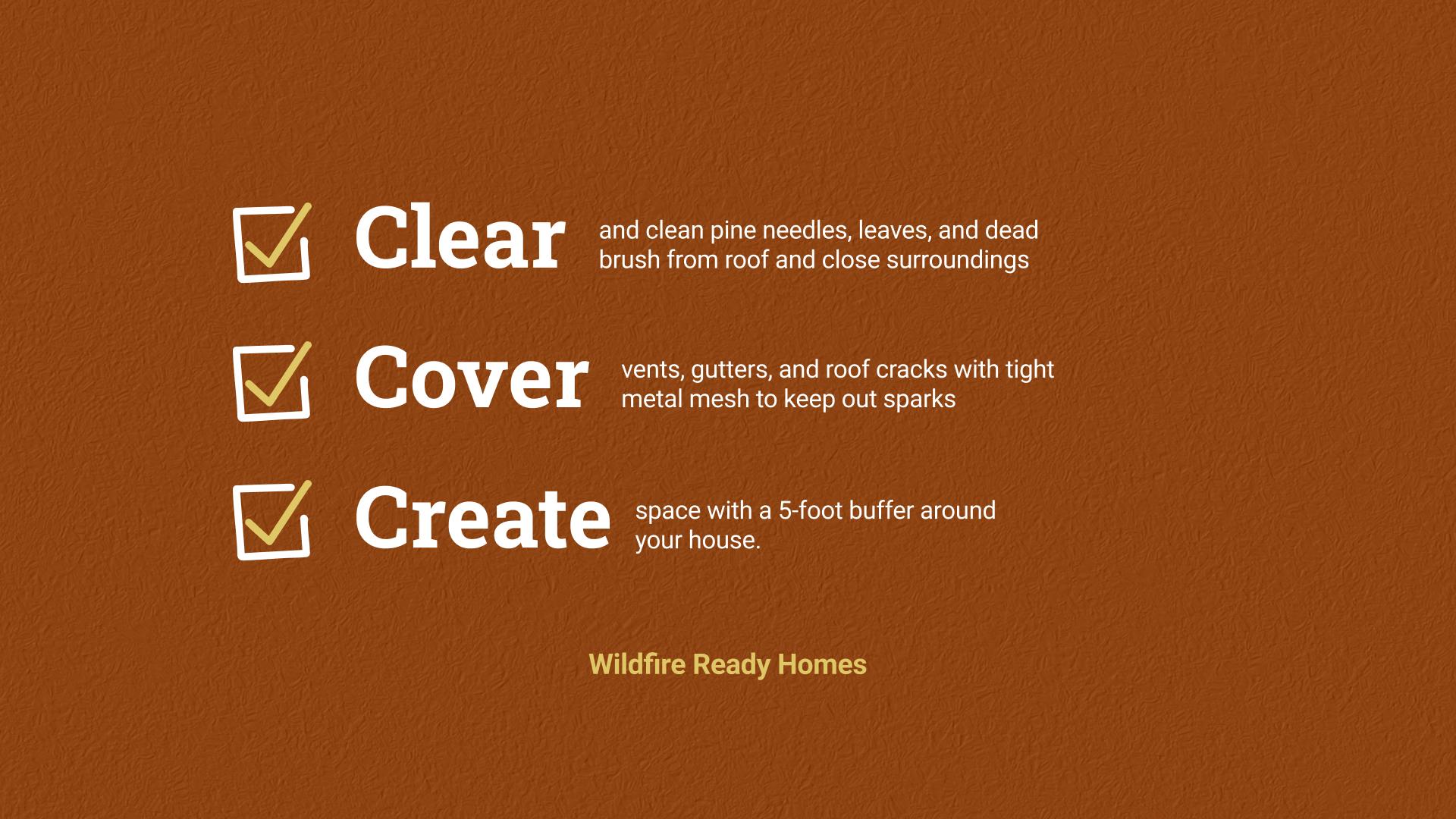
The campaign collateral focused on three actions that research indicated could have both a positive impact on fire-readiness in communities, and meet the homeowners’ bar for relative cost, ease, and impact:
Clear: Remove leaves, pine needles, and other flammable debris.
Cover: Protect vulnerable openings where embers can enter a home.
Create space: Maintain defensible space around the home by reducing vegetation and combustible materials.
Together, the actions gave homeowners a shorter, clearer starting point for preparing their homes. The research also gave the campaign direction for a broad message that reframed wildfire preparedness from a complicated responsibility for homeowners, into a few simple and meaningful actions that better protect their homes, families, and neighborhoods.
The creative approach sought to make preparedness feel achievable. Built around a “weekend warrior” concept, campaign materials showed people working on their own properties rather than focusing primarily on images of wildfire itself. Video content prioritized trusted local messengers, particularly firefighters and real homeowners, and used recognizable properties in high-risk neighborhoods to reinforce the idea that preparedness is both individual and collective.
Results in pilot communities
The Santa Barbara and Flagstaff pilots provided an opportunity to test how different communications channels could support different goals. YouTube and streaming video allowed residents to see the message, while Nextdoor was particularly effective at encouraging people to click through and explore preparedness resources.
Video content, featuring local firefighters and homeowners, became an especially valuable way to make the campaign’s action-oriented approach tangible. Rather than simply telling homeowners what to do, the short videos showed real people taking those actions around their homes, alongside trusted local firefighters who could reinforce why those actions matter.
Together, these digital channels created a “surround sound” effect, allowing residents to encounter the message in different formats and contexts rather than relying on a single touchpoint. Overall, we saw strong engagement with the content, indicating that this approach resonated well in both communities.
The positive reception and engagement with the campaign content reinforced the importance of thoughtfully prioritizing, framing, and delivering wildfire preparedness information. By making preparedness options feel specific and achievable, using trusted local voices, and reaching homeowners through multiple channels, Our Wildfire Ready Homes offers a model for how communications can help close the gap between awareness of wildfire risk and taking the first steps toward preparedness.

Message sent
Thank you for sharing.