2025 marked the Moore Foundation’s 25th anniversary. To commemorate this milestone, we launched a symposium series exploring topics related to the foundation’s mission. These events offer a chance to reflect on the progress of the past 25 years — and, as importantly, to envision the opportunities that lie ahead.
Most of the universe is invisible to us. The Standard Model of particle physics and cosmology describes the fundamental building blocks of matter with extraordinary precision, and it still accounts for only a small fraction of what is out there.
A new generation of sensors are making progress along several directions on understanding where the missing mass of the universe lies. Among these are probes looking to sense “dark matter” and a new take on measuring the mass of the elusive neutrino.
In October 2025, the Gordon and Betty Moore Foundation partnered with the American Physical Society’s Division of Nuclear Physics to convene researchers in Chicago. Titled “Physics beyond the Standard Model,” the gathering was held alongside the division’s annual meeting and formed part of a symposium series marking the foundation’s 25th anniversary.
Participants discussed new tools and innovative uses of existing experimental strategies that allow physicists to explore new frontiers. The event helped foster collaboration across many disciplines and drive innovation in next-generation detection techniques for rare isotope studies, weak interaction measurements, and new physics searches.
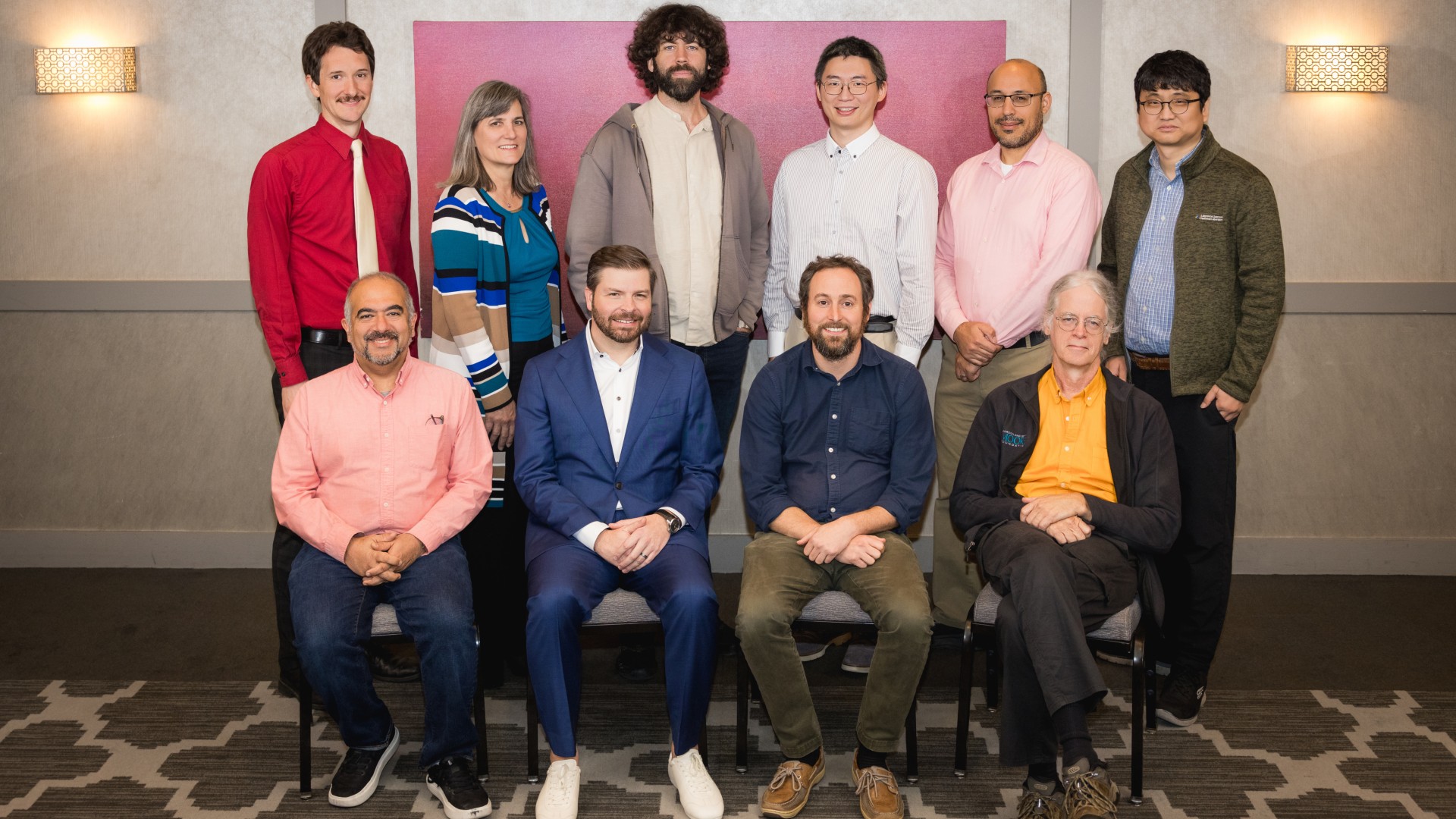 Credit: Fig Media
A different way of measuring
For decades, testing the Standard Model has meant building ever-larger detectors and colliders. This gathering’s focus was different. A new generation of tools is emerging: superconducting detectors, cryogenic detectors, and optomechanical sensors that trap microscopic particles in laser light. Some tools are sensitive enough to register the recoil of a single nucleus and potentially help measure the mass of the neutrino.
Walter Pettus, Ph.D., a physicist at Indiana University Bloomington, who studies the neutrino, saw a showcase of how far detection has come. “The most fun thing … is the recoil detection techniques that can go to really low energy,” he said. “That’s just a totally different way of doing detection from traditional nuclear physics experiments.”
Where different fields meet
The event brought together physicists from a wide range of specialties. “Bringing people together from different fields across this landscape allows them to interact with each other and think about ways that they can work together or think about a new thing that they could do,” said Theodore Hodapp, Ph.D., program director for the foundation’s Experimental Physics Investigators Initiative.
“The development that we do in fundamental science really lays the groundwork for how society evolves forward,” said Kyle Leach, Ph.D., a nuclear physicist at Queen’s University and Moore Foundation Experimental Physics Investigator. As one of the symposium’s organizers, he noted that the impact of the collective work in the field reaches well beyond any single experiment.
That cross-pollination helps to accelerate discovery, observed Catherine Mader, Ph.D., program officer for the Initiative. “If you bring them together, they give it a chance to go, ‘Oh, hey, this is a new tool, a new measurement we could make.’ And everybody advances their field.”
Looking ahead
Meaningful support for leading-edge scientific niches can make a substantial difference in what researchers can attempt. This symposium revealed how far the field has come and the wealth of opportunities ahead. The advancements in instrumentation are enabling experimentation previously seen as out of reach.
How instrumentation and experimentation evolve in these fields will help shape fundamental physics over the decades ahead.

Message sent
Thank you for sharing.